Movement
Simple Exercises That Could Save You From a Dangerous Fall

Health Points
- Balance deteriorates naturally with age, but targeted exercises can maintain stability and prevent falls
- Experts recommend practicing single-leg stands, heel-to-toe walking, and core-strengthening movements several times weekly
- Even beginners can start with chair-supported exercises and progress to more challenging variations
Falls remain one of the leading causes of serious injury among Americans over 40, yet most people don’t realize that simple daily exercises can dramatically reduce this risk. Physical therapists and fitness experts agree that balance training belongs in every adult’s wellness routine, regardless of current fitness level.
Balance is a skill we often take for granted until it begins to fade. The good news is that stability can be maintained and even improved through consistent practice of targeted movements.
“Balance training is just as important as cardiovascular exercise or strength training,” says Dr. Michael Chen, a physical therapist specializing in fall prevention. “We see patients in their 50s, 60s, and beyond who regain remarkable stability through dedicated practice.”
The foundation of balance training starts with awareness. Understanding where your body is in space—what experts call proprioception—forms the basis of all stability work. This sense can diminish with age, but exercises specifically designed to challenge it can restore and enhance the body’s natural equilibrium systems.
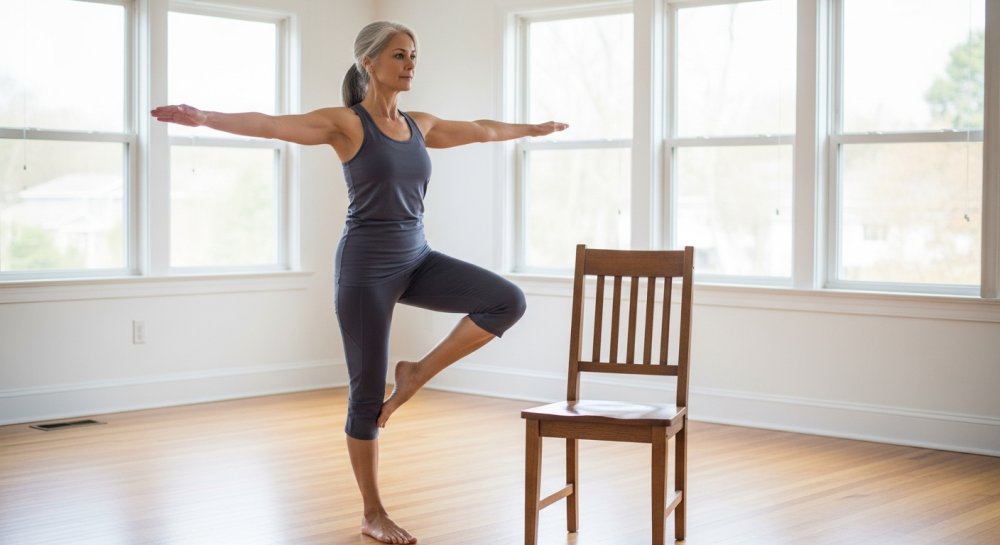
Single-leg stands represent the simplest entry point into balance training. Standing on one foot for 20 to 30 seconds, with a chair nearby for support if needed, activates the stabilizing muscles throughout the leg, ankle, and core. Beginners should start with brief intervals and gradually extend the duration as confidence builds.
Heel-to-toe walking, also known as tandem walking, mimics the sobriety test police officers use—and for good reason. This exercise challenges the body’s ability to maintain stability while in motion. Walking in a straight line with one foot directly in front of the other, heel touching toe, engages different balance mechanisms than static standing.
Chair sits and stands build the leg strength essential for stability. Rising from a seated position without using hands for support strengthens the quadriceps, glutes, and core muscles that keep us upright throughout daily activities. This functional movement translates directly to real-world situations like getting up from the dinner table or rising from a car seat.
“The muscles we use for balance are the same ones that keep us independent as we age,” notes Dr. Chen. “Every time you practice these movements, you’re investing in your future mobility.”
Side leg raises target the hip abductors, muscles critical for lateral stability. Standing near a wall or counter for light support, lifting one leg out to the side activates muscles that prevent sideways falls—particularly important when navigating uneven surfaces or crowded spaces.
Back leg raises work the posterior chain, including the glutes and lower back muscles. These movements improve stability during walking and protect against backward falls. Holding each raised position for a few seconds before lowering builds both strength and control.
The modified tree pose, borrowed from yoga, combines balance with gentle stretching. Standing on one leg while placing the opposite foot against the ankle, calf, or inner thigh creates a challenging but adaptable exercise. Using a wall for fingertip support makes this accessible even for beginners.
Marching in place elevates the heart rate while practicing weight transfer from one leg to the other. This dynamic movement prepares the body for the constant balance adjustments required during regular walking. Lifting knees higher increases the challenge and engages the core more thoroughly.
Toe and heel raises strengthen the ankles and calves, which serve as the first line of defense against stumbles. Rising onto the toes, holding for a moment, then rocking back onto the heels creates a simple but effective ankle-strengthening routine that can be performed almost anywhere.
Clock reaches combine balance with functional movement patterns. Standing on one leg, reaching the opposite leg out to different “hours” on an imaginary clock face challenges stability in multiple directions. This exercise particularly benefits those who need to reach for objects while standing.
Safety considerations matter more than speed or perfection. Practicing near a sturdy counter or wall ensures support remains available if needed. Wearing stable, flat-soled shoes—or going barefoot on non-slip surfaces—provides better ground contact than thick-soled athletic shoes.
Consistency trumps intensity in balance training. Practicing for just 10 to 15 minutes three or four times weekly produces better results than occasional marathon sessions. The nervous system adapts through regular repetition, gradually making stability feel more automatic.
“I tell my patients to think of balance training like brushing their teeth,” Dr. Chen explains. “It’s a small daily investment that prevents major problems down the road.”
Common obstacles include feeling self-conscious about wobbling or believing balance cannot improve. Yet wobbling is actually the training mechanism—the body learns by correcting itself repeatedly. Every correction strengthens the neural pathways that maintain stability.
Environmental factors also influence balance ability. Adequate lighting, clear walkways, and non-slip surfaces support safe practice. Removing tripping hazards like loose rugs or electrical cords creates a more stable home environment that complements exercise efforts.
Vision plays a surprisingly large role in balance. Many people don’t realize how much they rely on visual cues for stability until they try balance exercises with eyes closed. This advanced variation should only be attempted after mastering the basic versions with eyes open and support nearby.
Medications can affect balance, particularly those that cause dizziness or lightheadedness. Anyone experiencing sudden balance changes or dizziness should consult their physician to rule out medical causes or medication interactions.
The mental benefits of improved balance extend beyond physical safety. Confidence in one’s stability encourages more social activities, outdoor recreation, and independent living. Fear of falling often limits lifestyle choices more than actual physical limitations do.
Tracking progress helps maintain motivation. Noting how long you can stand on one leg without support, or how many chair stands you can complete, provides concrete evidence of improvement. These small victories build momentum for continued practice.
Advanced variations keep the exercises challenging as ability improves. Standing on unstable surfaces like foam pads, closing eyes during static holds, or combining arm movements with leg exercises all increase difficulty appropriately for those ready to progress.
Balance training complements other health initiatives rather than replacing them. Walking, strength training, and flexibility work all contribute to overall stability. The most comprehensive approach addresses multiple aspects of physical fitness.
For those recovering from injuries or managing chronic conditions, working with a physical therapist ensures exercises match individual capabilities and limitations. Professional guidance helps avoid compensatory movement patterns that could create new problems while addressing balance concerns.
The return on investment for balance training proves remarkable. A few minutes of daily practice can mean the difference between aging with confidence and independence versus living in fear of the next stumble. The choice to prioritize stability today protects quality of life for years to come.
