Movement
This 15-Minute Routine Could Transform Your Balance and Strength After 60

Health Points
- A targeted core and mobility routine can significantly improve balance, stability, and daily function for women over 60
- The workout combines planks, bridges, and mobility exercises designed specifically for aging bodies
- Consistency matters more than intensity — even 15 minutes several times per week shows measurable benefits
For women entering their seventh decade, maintaining core strength and mobility isn’t just about fitness — it’s about independence. A new routine designed by a personal trainer specializing in mature clients offers a practical approach to staying strong, stable, and active well into retirement years.
The workout focuses on fundamental movements that address the specific challenges women face after 60. Changes in hormone levels, decreased bone density, and natural muscle loss make targeted exercise more important than ever.
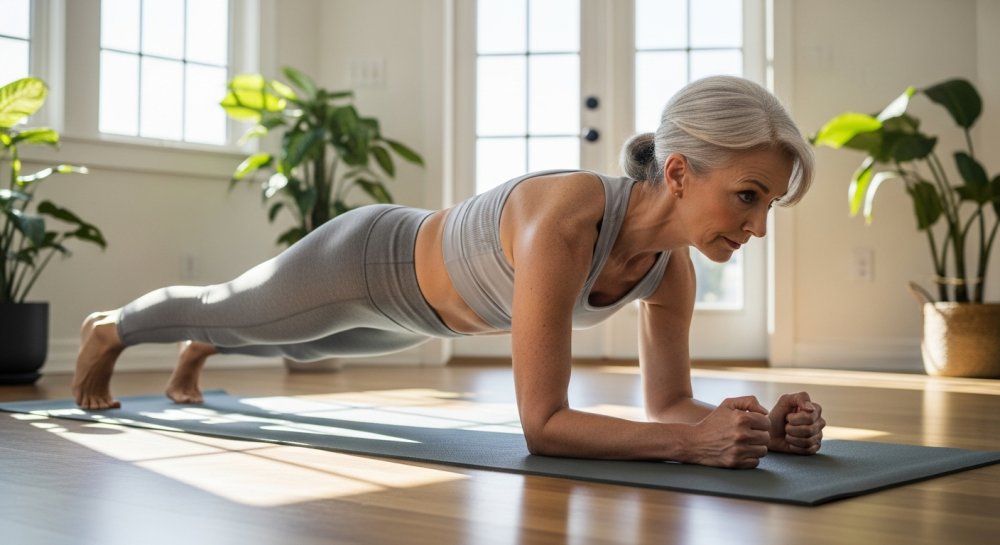
The routine centers on five key exercises: modified planks for core stability, glute bridges to strengthen the posterior chain, cat-cow stretches for spine mobility, standing leg raises for balance, and seated spinal twists for flexibility. Each movement can be adapted to individual fitness levels, making the program accessible whether you’re already active or just beginning a fitness journey.
“The goal isn’t to train like you’re 30 again,” the trainer explains.
“It’s about building the strength and mobility you need for the life you want to live now — gardening, playing with grandchildren, traveling, or simply moving through your day without pain or limitation.”
Core strength becomes increasingly vital with age because it protects the spine, improves posture, and reduces fall risk. Women who maintain strong cores report better balance, less back pain, and greater confidence in daily activities. The bridge exercise specifically targets the glutes and lower back, areas that often weaken with prolonged sitting and age-related muscle loss.
Mobility work addresses the stiffness many women experience in their 60s. The cat-cow stretch gently moves the spine through its full range of motion, counteracting the forward-hunched posture that develops from years of computer work and daily activities. Standing leg raises challenge balance while strengthening hip stabilizers — crucial muscles for preventing falls, one of the most serious health risks for older women.
The seated spinal twist maintains rotational mobility, which impacts everything from driving safely to reaching for items on shelves. This often-overlooked movement pattern deteriorates quickly without regular practice, leading to compensatory movements that can cause injury.
Experts recommend performing this routine three to four times weekly, allowing rest days between sessions for recovery. Starting with just one set of each exercise and gradually building to two or three sets over several weeks prevents overtraining while building sustainable strength.
The beauty of this approach lies in its simplicity and adaptability. Each exercise can be modified — planks can be done against a wall, bridges can start with a smaller range of motion, and balance work can incorporate a chair for support. As strength improves, the movements can be progressed by adding time, repetitions, or difficulty.
Women who’ve adopted similar routines report noticeable improvements within weeks. Better balance when walking on uneven surfaces, easier transitions from sitting to standing, reduced morning stiffness, and increased confidence in physical activities all stem from consistent practice of these fundamental movements.
Beyond the physical benefits, maintaining an exercise routine in your 60s supports cognitive health, mood regulation, and social connection when practiced in group settings. The routine requires minimal equipment — just a yoga mat and comfortable clothing — making it accessible regardless of budget or access to fitness facilities.
Healthcare providers increasingly recognize that strength and mobility training may be as important as cardiovascular exercise for older adults. The combination addresses multiple aspects of healthy aging simultaneously, from bone density to metabolic health to injury prevention.
For women concerned about osteoporosis, weight-bearing exercises like standing leg raises provide bone-strengthening benefits. The bridge exercise engages major muscle groups, supporting metabolic health and helping maintain healthy body composition as metabolism naturally slows with age.
The key to success isn’t perfection but consistency. Even on days when energy is low, completing a shortened version of the routine maintains the habit and keeps muscles engaged. Progress may feel slow compared to younger years, but the functional benefits — moving through life with less pain and greater ease — accumulate steadily with regular practice.
This approach to fitness recognizes that health after 60 looks different than it did at 30 or 40. Rather than chasing arbitrary fitness standards, the focus shifts to maintaining the physical capacity for a full, active life. That practical goal makes exercise feel less like a chore and more like an investment in continued independence and vitality.
