Movement
Why This Simple Squat Variation Transforms Lower Body Strength After 40

Health Points
- Goblet squats improve balance and core stability while reducing injury risk compared to traditional barbell squats
- This beginner-friendly exercise strengthens major leg muscles and promotes better daily movement patterns
- Starting with lighter weights allows perfect form development before progressing to heavier loads
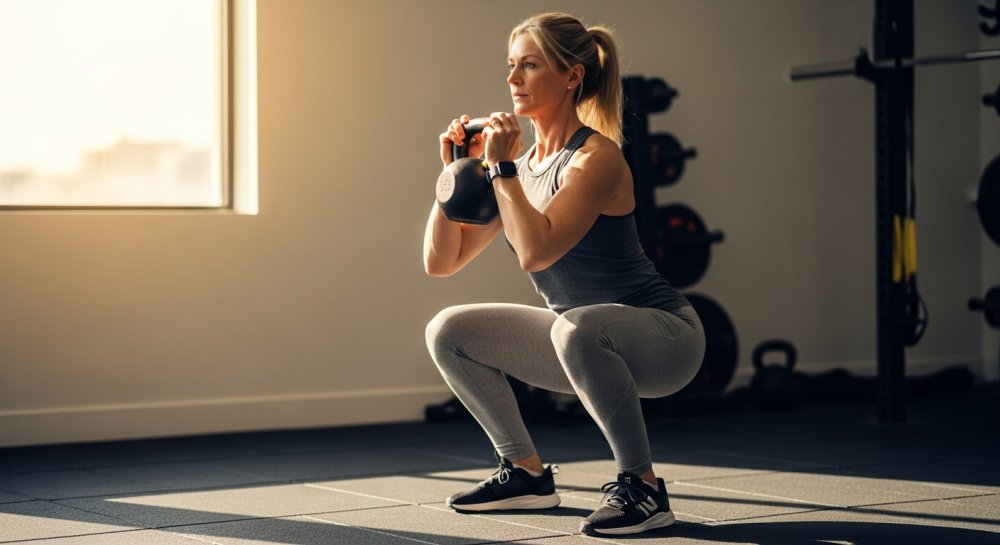
For adults over 40 looking to maintain strength and mobility, a single exercise variation might offer more benefits than traditional workout staples. The goblet squat—performed while holding a weight at chest level—delivers comprehensive lower body conditioning without the complexity or injury risk of barbell exercises.
This modified squat pattern activates the quadriceps, glutes, hamstrings, and core muscles simultaneously. Unlike back-loaded exercises, the weight placement naturally encourages proper posture and spinal alignment throughout the movement.
Physical therapists and strength coaches frequently recommend goblet squats for middle-aged adults beginning or returning to resistance training. The front-loaded weight serves as a natural counterbalance, making it easier to achieve proper depth while maintaining an upright torso position.
The exercise demands core engagement throughout the entire range of motion. As the weight pulls forward, abdominal and back muscles must activate to maintain stability, creating a functional fitness effect that translates directly to daily activities like lifting grandchildren or carrying groceries.
Balance improvement represents another significant advantage, particularly for aging adults concerned about fall prevention. The goblet position requires constant stabilization, training the body to maintain equilibrium under load—a skill that deteriorates naturally with age but responds well to targeted practice.
Joint-friendly mechanics make goblet squats accessible for those with previous injuries. The natural movement pattern reduces stress on the lower back compared to traditional barbell squats, while the upright position decreases forward knee travel that can aggravate existing conditions.
Executing proper form begins with weight selection: start with a dumbbell or kettlebell between 10-20 pounds. Hold the weight vertically against your chest with both hands supporting the top end, elbows pointing downward.
Stand with feet slightly wider than shoulder-width, toes angled outward approximately 15 degrees. This stance creates optimal hip mobility and prevents knees from collapsing inward during the descent.
Initiate the movement by pushing hips backward while simultaneously bending knees, maintaining an upright chest position throughout. The weight should remain stable against the chest—any forward drift indicates core weakness or improper form.
Descend until thighs reach parallel with the floor, or slightly below if mobility allows. Knees should track over toes without extending beyond them excessively. Hold briefly at the bottom position before driving through heels to return to standing.
Breathing technique supports performance and safety: inhale during the descent, hold briefly at the bottom, then exhale forcefully while rising. This breathing pattern creates intra-abdominal pressure that protects the spine under load.
Beginners should target three sets of 8-10 repetitions, focusing entirely on movement quality rather than weight progression. Mastering the pattern with lighter resistance establishes neuromuscular coordination that prevents injury when advancing to heavier loads.
Common mistakes include allowing knees to cave inward, rounding the upper back, or rising onto toes during the descent. Each error compromises the exercise’s effectiveness and increases injury risk, particularly for those with age-related joint vulnerabilities.
For maximum benefit, incorporate goblet squats into a comprehensive strength program 2-3 times weekly. Allow at least 48 hours between sessions for adequate muscle recovery, especially when beginning a new training protocol after 40.
Progressive overload should occur gradually—increase weight only after consistently completing all prescribed repetitions with perfect form. For older adults, a 5-pound increment every 2-3 weeks represents appropriate progression that builds strength without overwhelming recovery capacity.
The versatility of goblet squats extends to home workouts, requiring minimal equipment and space. This accessibility removes common barriers to consistent training, supporting long-term adherence that produces lasting health benefits.
Research consistently demonstrates that lower body strength correlates directly with longevity and quality of life in aging populations. Maintaining leg and hip strength preserves independence, reduces fall risk, and supports metabolic health through muscle mass preservation.
