Health
The Science Behind Safely Working With Research Peptides

Health Points
- Proper peptide storage requires refrigeration at specific temperatures to maintain molecular stability and research integrity
- Reconstitution technique directly impacts peptide effectiveness, with precise measurements and sterile water being essential
- Understanding handling protocols helps researchers avoid common contamination and degradation mistakes
Peptides have become a hot topic in wellness circles, sparking conversations across recovery communities, skincare forums, and health optimization groups. Yet for all the enthusiasm, many people remain unclear about the fundamental science behind handling these delicate molecules.
Understanding proper peptide management matters more than most realize. These short chains of amino acids are remarkably sensitive to environmental conditions, and improper handling can render them ineffective before they’re ever used.
The storage challenge begins the moment peptides arrive. Unlike supplements that can sit in a cabinet, research peptides demand refrigeration at temperatures between 2°C and 8°C (36°F to 46°F). Freezer storage at -20°C works for longer-term preservation of lyophilized (freeze-dried) powder forms.
Temperature fluctuations pose the greatest threat to peptide stability. Each warming and cooling cycle can damage the molecular structure, which is why researchers emphasize keeping vials sealed and minimizing time outside controlled environments.
Light exposure presents another vulnerability. Peptides degrade when exposed to direct sunlight or even bright indoor lighting for extended periods. Amber-colored vials offer some protection, but storage in dark environments provides optimal preservation.
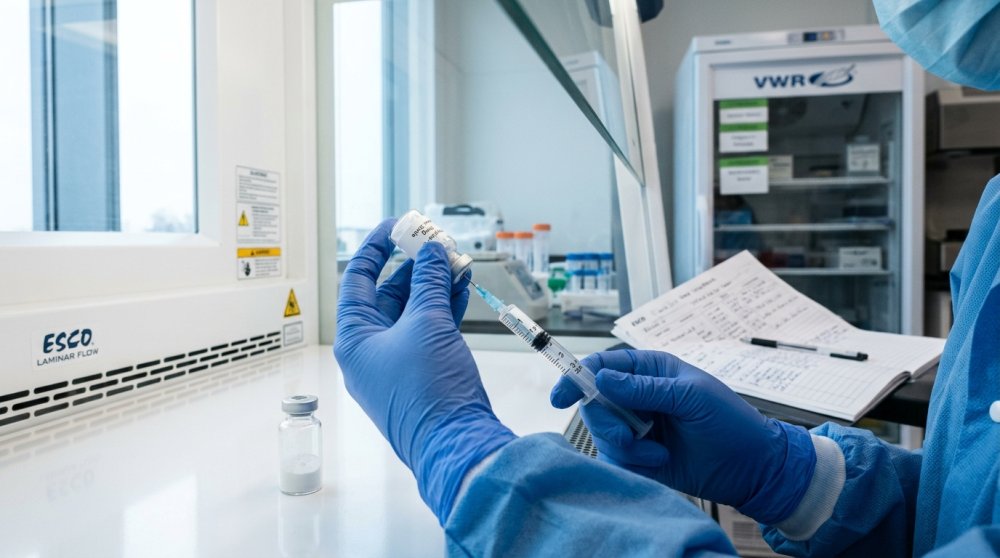
Reconstitution — the process of mixing lyophilized peptides with bacteriostatic water — requires careful attention to technique. The goal is dissolving the powder completely without introducing contamination or creating excessive agitation that might denature the peptide chains.
Most protocols call for sterile bacteriostatic water, which contains a small amount of benzyl alcohol to prevent bacterial growth. Researchers inject the water slowly down the inside wall of the vial rather than directly onto the powder, allowing gradual dissolution without forceful mixing.
The reconstituted solution should appear clear, not cloudy. Any cloudiness, particles, or discoloration signals potential degradation or contamination, making the preparation unsuitable for research purposes.
Once mixed, peptide solutions have shorter shelf lives than their powdered counterparts. Most remain stable for two to three weeks when refrigerated, though specific peptides vary in their resilience. Keeping detailed preparation dates helps researchers track freshness and maintain protocol integrity.
Sterile technique throughout the process cannot be overstated. Working with peptides means treating them with the same care given to any laboratory-grade substance — clean workspace, alcohol swabs for vial tops, and proper disposal of used materials.
Common mistakes include using tap water instead of bacteriostatic water, shaking vials vigorously, and leaving reconstituted peptides at room temperature. Each of these shortcuts compromises the molecular structure and research outcomes.
Documentation serves as another cornerstone of proper peptide work. Researchers who maintain logs of storage conditions, reconstitution dates, and handling observations build valuable records that help identify patterns and ensure consistency across experiments.
The rise of peptide interest among health-conscious adults over 40 brings both opportunities and responsibilities. As more people explore these compounds for research purposes, understanding the basics of proper handling becomes essential for maintaining both safety and scientific validity.
Quality sourcing matters as much as handling technique. Reputable suppliers provide certificates of analysis showing purity levels, typically above 98%, along with proper packaging designed for peptide preservation during shipping.
For those new to peptide research, starting with smaller quantities allows practice with handling protocols before investing in larger supplies. This approach reduces waste while building confidence in reconstitution techniques and storage management.
The precision required for peptide work might seem daunting initially, but it quickly becomes routine with practice. Many researchers find that methodical attention to these details enhances their overall approach to health experimentation and self-optimization.
As the wellness community continues exploring peptides’ potential applications, maintaining rigorous handling standards ensures that research remains meaningful and results remain interpretable. Whether investigating recovery support, cognitive enhancement, or metabolic function, proper technique forms the foundation of credible exploration.
The fundamentals of peptide handling — controlled temperature, light protection, sterile reconstitution, and careful documentation — represent more than laboratory protocol. They reflect a commitment to doing wellness research right, with the same respect for scientific method that professional researchers bring to their work.
