Movement
The Five-Minute Ankle Fix That Changes Everything

Health Points
- Ankle mobility affects balance, walking efficiency, and injury prevention as we age
- Five simple exercises can be performed daily without equipment in just minutes
- Improved ankle flexibility supports better posture and reduces fall risk for adults over 40
Your ankles do more work than you realize. Every step, every pivot, every time you stand up—your ankle joints are quietly managing forces that keep you balanced and moving forward. Yet for many Americans over 40, limited ankle mobility has become an invisible barrier to confident, pain-free movement.
Physical therapists and movement specialists are highlighting a straightforward solution: five targeted exercises that take less time than brewing your morning coffee. No gym membership required, no special equipment needed—just a few minutes of focused attention to the joints that literally support everything you do.
“Ankle mobility is one of the most overlooked aspects of functional fitness,” explains Dr. Sarah Chen, a sports medicine physician based in Dallas. “When your ankles can’t move through their full range of motion, your knees and hips compensate, which can lead to pain and instability throughout your entire kinetic chain.”
The benefits extend beyond athletic performance. For adults navigating middle age and beyond, flexible ankles mean better balance on uneven surfaces, easier navigation of stairs, and reduced risk of the falls that send thousands of Americans to emergency rooms each year.
Ankle Circles: The Warm-Up Essential
Begin seated with one leg extended. Slowly rotate your foot in complete circles, first clockwise for ten repetitions, then counterclockwise. The movement should originate from the ankle joint itself, not from rotating your entire leg.
This foundational exercise increases synovial fluid production—the body’s natural joint lubricant—and gently reminds your ankles of their full rotational capacity. Many people discover they can barely complete a smooth circle on their first attempt, a wake-up call about how restricted their mobility has become.
Toe Raises and Heel Drops: Building Strength and Flexibility
Standing near a wall for balance support, rise onto your toes as high as comfortable, hold for two seconds, then slowly lower back down. Complete 15 repetitions. This simple movement strengthens the calf muscles while encouraging the ankle to flex through its complete range.
For an added challenge, perform heel drops by standing on a step with your heels hanging off the edge. Lower your heels below the level of the step, feeling a gentle stretch through your Achilles tendon and calf, then rise back to neutral.
Ankle Dorsiflexion Stretch: The Tight-Calf Solution
Place your hands against a wall and step one foot back, keeping that heel firmly planted on the ground. Bend your front knee while keeping your back leg straight, creating a stretch along the back of your lower leg. Hold for 30 seconds, then switch sides.
“Most people spend their days in shoes that restrict natural foot movement and in positions that keep ankles in a limited range,” notes physical therapist Marcus Williams. “This stretch specifically targets the muscles and tendons that become chronically shortened from our modern lifestyle.”
The key is keeping that back heel down—many people want to let it lift, which defeats the purpose of the stretch. You should feel a gentle pulling sensation, never pain.
Alphabet Tracing: The Coordination Builder
Sitting comfortably, extend one leg and use your big toe to “write” the alphabet in the air. This playful exercise forces your ankle through multiple planes of motion, improving both flexibility and neuromuscular control—the brain-body connection that keeps you steady on your feet.
The complete alphabet takes roughly two minutes per foot. It’s an ideal exercise while watching television or during work breaks, and the cognitive element of letter formation adds a coordination challenge that purely repetitive movements lack.
Calf Stretch Against a Wall: The Deep Release
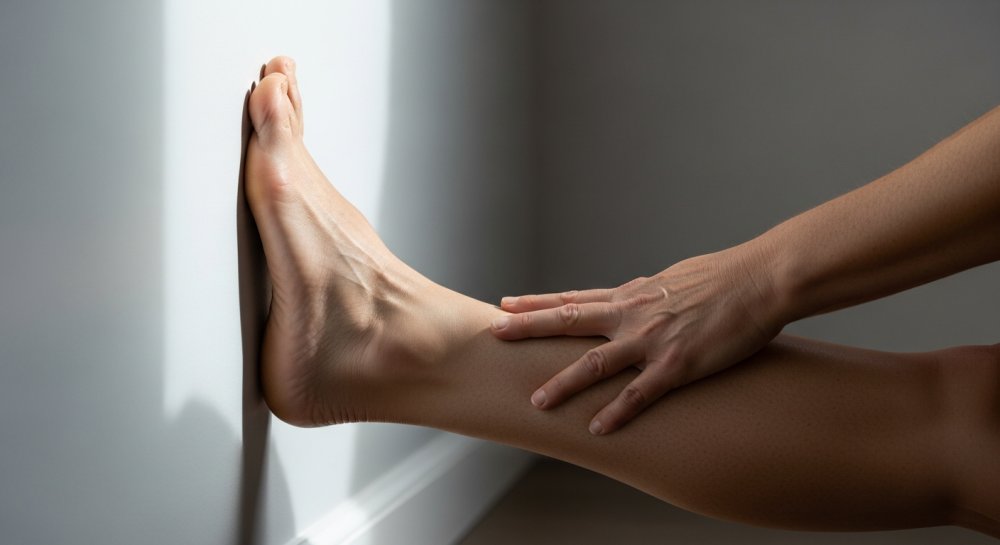
Face a wall and place the ball of one foot against it, heel on the floor, creating an angled position. Lean forward gently until you feel a stretch through your calf and the front of your ankle. Hold for 30 seconds per side.
This wall variation allows for a deeper stretch than traditional calf stretches and specifically targets the anterior ankle capsule—the tissue that becomes restricted in people who spend long hours sitting or wearing restrictive footwear.
Consistency matters more than intensity with ankle mobility work. Physical therapists recommend performing these five exercises daily, ideally in the morning when joints are typically stiffer. Within two to three weeks, most people notice improved ease of movement, better balance, and reduced stiffness during their first steps after sitting.
For individuals with existing ankle injuries, arthritis, or chronic pain, consultation with a healthcare provider before beginning any new exercise routine remains important. But for the majority of adults, these gentle movements represent a low-risk, high-reward investment in long-term mobility and independence.
The foundation of confident movement starts at the ground—quite literally with the joints that connect you to it.
