Health
Seven Atopic Dermatitis Signs That Often Go Unnoticed on Darker Skin Tones

Health Points
- Atopic dermatitis appears differently on darker skin, often showing gray, purple, or dark brown patches instead of red inflammation
- People with darker skin tones may experience more severe complications including hyperpigmentation and lichenification
- Medical education historically focused on light skin presentations, leading to delayed diagnosis and treatment for many patients
Atopic dermatitis, commonly known as eczema, affects millions of Americans regardless of skin tone. Yet the condition manifests differently across diverse populations, creating diagnostic challenges that can delay proper treatment for those with darker complexions.
Medical professionals increasingly recognize that standard descriptions of atopic dermatitis symptoms—typically based on how the condition appears on lighter skin—fail to capture the full range of presentations. This gap in medical education has real consequences for patient care and outcomes.
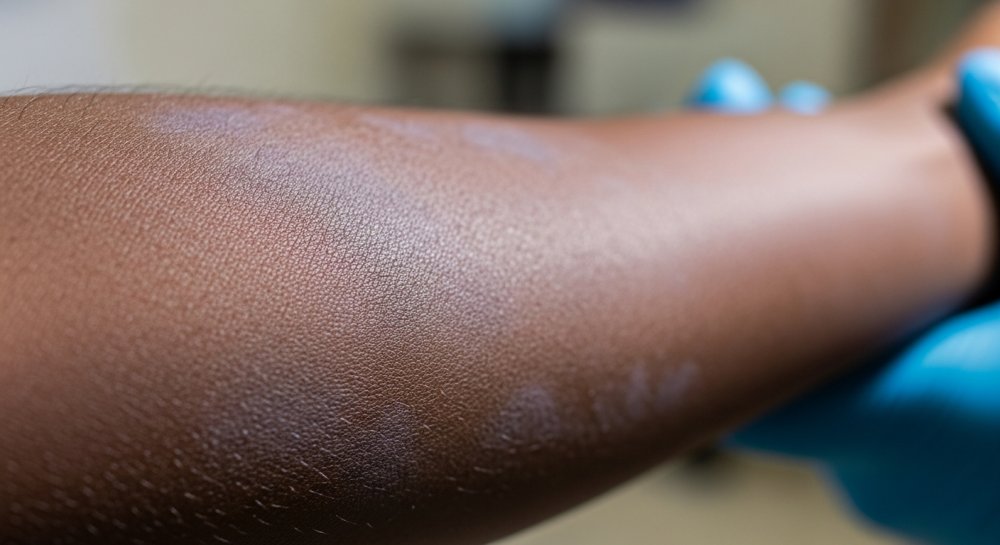
The inflammation that appears pink or red on lighter skin often presents as gray, purple, or dark brown on darker skin tones. This fundamental difference means that many people of color experience delayed diagnosis or misdiagnosis when healthcare providers rely solely on traditional symptom descriptions.
Beyond the visible differences in inflammation color, people with darker skin face additional complications from atopic dermatitis. Hyperpigmentation—dark patches that persist long after inflammation subsides—occurs more frequently in those with higher melanin levels.
Post-inflammatory changes can last months or even years, creating ongoing cosmetic concerns that extend well beyond the active disease period. These darkened areas represent areas where the skin produced excess melanin in response to inflammation.
Lichenification, a thickening and leathering of the skin caused by repeated scratching, also appears more prominently on darker skin. The affected areas take on a rough, bark-like texture with exaggerated skin lines that can be particularly noticeable.
Follicular prominence—small bumps around hair follicles that create a sandpaper-like texture—represents another presentation more common in darker-skinned patients. These bumps can cover large areas and are often mistaken for other conditions.
The dryness associated with atopic dermatitis appears more obvious on darker skin, where it often creates an ashy or grayish appearance. This visible dryness occurs because the compromised skin barrier allows moisture to escape more readily.
Papular eczema, characterized by small, firm bumps rather than the typical patches, occurs more frequently in people with skin of color. This variant can be particularly itchy and may not respond to standard treatments in the same way.
The distribution of lesions may also differ, with darker-skinned individuals more likely to develop symptoms on the extensor surfaces—the outer parts of arms and legs—rather than the flexural areas like inner elbows and behind knees where eczema typically appears on lighter skin.
Medical textbooks and training materials have historically featured predominantly light-skinned patients, creating knowledge gaps among healthcare providers. This educational deficit means some doctors may not recognize atopic dermatitis when examining patients with darker complexions.
Recent efforts to diversify medical education materials aim to address this disparity. Several dermatology organizations now emphasize the importance of learning to recognize skin conditions across all skin tones as a matter of healthcare equity.
Proper diagnosis requires healthcare providers to look beyond color changes and consider the full constellation of symptoms including itch intensity, location, chronicity, and associated features like dry skin or family history of allergic conditions.
Treatment approaches remain largely the same across skin types, focusing on moisturization, inflammation control, and itch management. However, addressing post-inflammatory hyperpigmentation may require additional interventions for those with darker skin.
Patients can advocate for themselves by describing all symptoms clearly, including itching, sleep disturbance, and any changes in skin texture or appearance. Taking photographs of affected areas during flare-ups helps document the condition’s progression.
Early recognition and treatment of atopic dermatitis prevents complications and improves quality of life. Those who suspect they have the condition should seek evaluation from a dermatologist, particularly one with experience treating diverse patient populations.
The growing awareness of how skin conditions present across different ethnicities represents an important step toward more equitable healthcare. Improved recognition ultimately means better outcomes for all patients with atopic dermatitis.
