Health
Why Emergency Physicians Say Digital Thermometers Beat Old-School Methods Every Time

Health Points
- Digital thermometers provide accurate readings in seconds, far surpassing traditional mercury models that took minutes and posed safety risks
- Temporal artery and ear thermometers offer hospital-grade accuracy for home use, ideal for families with young children
- Proper thermometer placement and technique matter more than price—even budget models work when used correctly
When it comes to monitoring your health at home, few tools prove as essential as a reliable thermometer. For adults over 40, accurate temperature readings help distinguish between minor illnesses and conditions requiring medical attention—a distinction that becomes increasingly important as we age.
Emergency medicine physicians consistently emphasize that the best thermometer isn’t necessarily the most expensive one. It’s the one you’ll use correctly and consistently.
“The technology in digital thermometers has advanced dramatically over the past decade,” explains Dr. Michael Chen, an emergency medicine specialist with over 20 years of clinical experience. “What used to require hospital equipment is now available for home use with remarkable accuracy.”
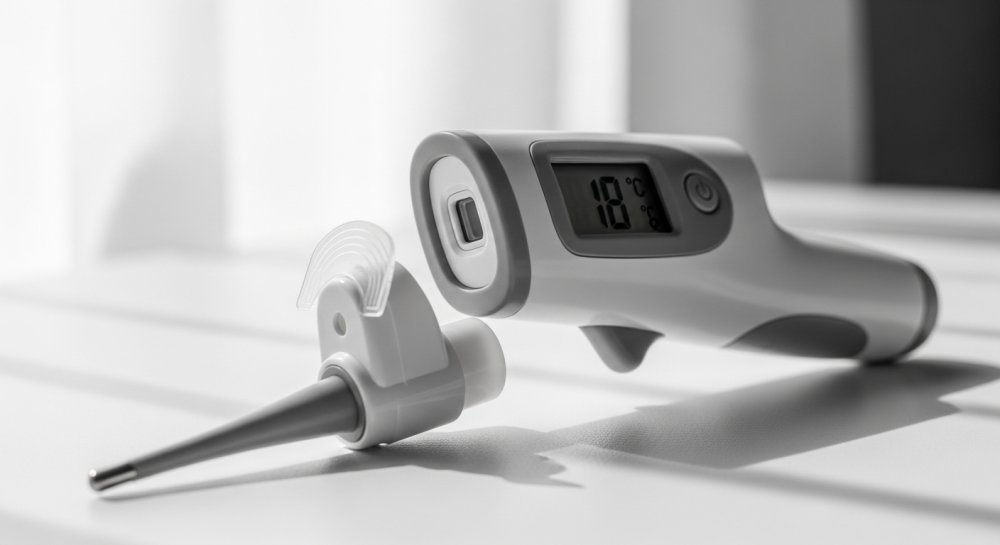
Modern thermometers fall into several categories, each with distinct advantages. Temporal artery thermometers scan the forehead and read the temperature of blood flowing through the temporal artery—one of the major vessels supplying the brain.
These devices offer particular benefits for older adults and those monitoring chronic conditions.
Ear thermometers, technically called tympanic thermometers, measure infrared heat waves from the eardrum. They deliver results in seconds and work well for most adults, though proper technique matters significantly.
“You need to pull the ear up and back to straighten the ear canal,” notes Dr. Sarah Williams, a family medicine physician. “Without proper positioning, readings can be off by a degree or more.”
Traditional oral digital thermometers remain the gold standard for accuracy when used properly. They require patience—typically two to three minutes under the tongue with the mouth closed—but deliver consistently reliable results.
For households caring for aging parents or managing multiple health conditions, having more than one type proves practical.
“I recommend families keep both a temporal artery thermometer for quick checks and an oral digital thermometer for verification,” suggests Dr. Chen. “The convenience factor means people actually take their temperature when they should, rather than putting it off.”
Several features distinguish quality thermometers from mediocre ones. Fast reading times—under 10 seconds for non-contact models—encourage regular monitoring.
Backlit displays help those with vision changes read results easily. Memory functions that store previous readings allow you to track fever patterns, information your doctor will appreciate during appointments.
“When patients come in and can tell me their temperature readings over the past few days, it completely changes the diagnostic conversation,” Dr. Williams explains. “Pattern recognition matters enormously in medicine.”
Fever-alert features that beep or change color when readings exceed normal ranges provide helpful immediate feedback, particularly for those living alone.
Temperature measurement seems straightforward, but common mistakes can skew results significantly. Taking your temperature immediately after hot or cold drinks throws off oral readings.
Wait at least 15 minutes after eating or drinking anything.
Environmental factors affect non-contact thermometers. Coming in from cold weather or taking a reading in a drafty room can produce falsely low results with temporal artery models.
Earwax buildup interferes with ear thermometer accuracy—something to consider for regular users.
“Clean the probe regularly with alcohol wipes,” advises Dr. Chen. “It’s a simple step that dramatically improves accuracy and prevents the spread of germs between family members.”
Battery maintenance matters more than many realize. Weak batteries produce unreliable readings well before the device stops working entirely.
Replace batteries at the first sign of sluggish response.
What constitutes a fever changes with age. While 98.6°F remains the often-cited “normal” body temperature, research shows normal ranges vary from 97°F to 99°F depending on the individual, time of day, and measurement method.
For adults, oral temperatures of 100.4°F or higher generally indicate fever. Temporal artery and ear readings typically run about 0.5 to 1 degree higher than oral temperatures.
Understanding these variations prevents unnecessary alarm.
“I see patients panic over 99.5°F readings that fall within their normal range,” Dr. Williams notes. “Take your temperature when you’re feeling well to establish your personal baseline.”
For those managing chronic conditions like autoimmune diseases or undergoing cancer treatment, even low-grade fevers warrant medical attention. In these cases, the precision and ease of home monitoring becomes not just convenient but medically critical.
The cost of thermometers ranges from under $10 for basic digital stick thermometers to over $100 for advanced temporal artery models with smartphone connectivity.
Value matters more than price point.
Reliable stick thermometers cost $15-25 and deliver excellent accuracy with proper use. Mid-range ear thermometers in the $30-50 range offer speed and convenience for most households.
Premium temporal artery thermometers justify their $60-100 price tags for families with young children or those requiring frequent monitoring.
“The best thermometer is the one that removes barriers to actually checking your temperature,” Dr. Chen emphasizes. “If speed matters most to you, invest in that. If accuracy is paramount, go oral. Match the tool to your needs.”
Smart thermometers that sync with phone apps provide valuable data tracking for tech-comfortable users. These devices automatically log readings with timestamps, create charts showing temperature trends, and even allow sharing information directly with healthcare providers.
For older adults managing multiple medications and conditions, this automatic record-keeping reduces the burden of manual tracking.
Calibration checks ensure ongoing accuracy. Most quality thermometers include instructions for testing against ice water (32°F) or boiling water (212°F at sea level).
Performing these checks annually confirms your device still measures accurately.
“If your thermometer consistently reads off by more than a degree during calibration tests, replace it,” advises Dr. Williams. “The cost of a new thermometer is trivial compared to the cost of delayed treatment because you didn’t realize you actually had a fever.”
Storage matters for longevity. Keep thermometers in protective cases away from extreme temperatures.
Bathroom medicine cabinets experience humidity fluctuations that can damage electronic components over time. A bedroom drawer or linen closet proves ideal.
For households with multiple residents, consider color-coding thermometers or assigning individual devices to prevent cross-contamination during illness. While cleaning between uses helps, dedicated thermometers provide extra protection during flu season.
The peace of mind that comes from accurately monitoring your health at home has real value. Quick, reliable temperature readings help distinguish between situations you can manage at home and those requiring professional medical attention.
“Empowered patients who monitor their health metrics make better decisions about when to seek care,” Dr. Chen concludes. “A good thermometer is fundamental to that empowerment.”
