Health
The Post-Pregnancy Abdominal Condition Half of All Mothers Experience

Health Points
- Diastasis recti affects nearly half of pregnant women, causing abdominal muscle separation that can persist long after delivery
- Physical therapy and targeted exercises successfully treat most cases without surgery within 6-12 months
- Medical intervention may be necessary when the separation exceeds specific measurements or causes functional problems
A common yet often misunderstood condition affects approximately half of all pregnant women, leaving many new mothers wondering why their midsection doesn’t return to its pre-pregnancy appearance. Diastasis recti, the medical term for abdominal muscle separation, occurs when the connective tissue between the left and right sides of the rectus abdominis muscles stretches and thins.
The condition develops as the growing uterus places increasing pressure on the abdominal wall during pregnancy. While the body naturally accommodates this expansion, the linea alba—the connective tissue running down the center of the abdomen—can stretch beyond its ability to return to its original position.
“This separation is a normal adaptation to pregnancy, but for many women it doesn’t fully resolve on its own,”
explains Dr. Sarah Mitchell, a pelvic floor physical therapist with over 15 years of experience treating postpartum women.
The hallmark sign of diastasis recti is a visible ridge or bulge running vertically down the center of the abdomen, particularly noticeable when performing movements like sitting up from a lying position. Some women also experience lower back pain, pelvic floor dysfunction, or a persistent “pooch” that exercise alone cannot eliminate.
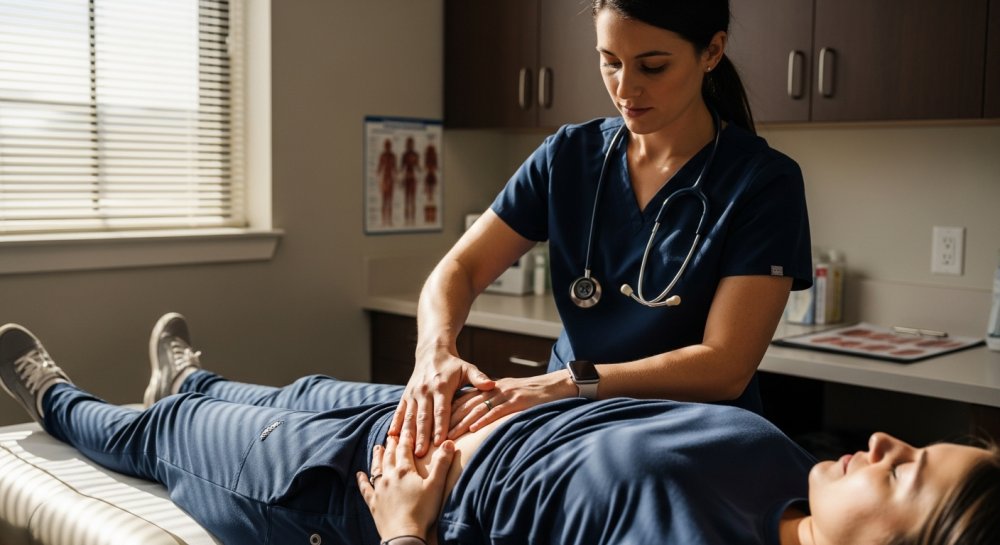
Healthcare providers diagnose the condition by measuring the separation between the abdominal muscles, typically during a physical examination. A gap wider than two finger-widths, or approximately two centimeters, generally indicates diastasis recti that may benefit from treatment.
Conservative treatment through physical therapy remains the first-line approach for most cases. Specialized exercises focus on strengthening the deep core muscles, particularly the transverse abdominis, which acts like a natural corset to draw the separated muscles back together.
“We’re not just doing crunches—in fact, traditional sit-ups can actually worsen the separation,”
notes physical therapist Jennifer Armstrong, who specializes in women’s health.
The therapeutic exercise program typically includes movements that engage the core while maintaining proper alignment and breathing patterns. Planks, modified versions of traditional exercises, and functional movements that mimic daily activities form the foundation of treatment.
Most women who commit to a consistent exercise program see significant improvement within six to twelve months. The key lies in proper technique and progressive strengthening rather than aggressive or high-volume training.
For some women, however, conservative measures prove insufficient. When the separation exceeds approximately three centimeters, causes significant functional impairment, or includes a hernia, surgical intervention may become necessary.
The surgical procedure, called abdominoplasty or “tummy tuck” when performed cosmetically, involves suturing the separated muscles back together. When performed for medical rather than cosmetic reasons, insurance may cover the procedure, though requirements vary significantly between providers.
Prevention strategies during pregnancy include maintaining appropriate weight gain, practicing good posture, and avoiding exercises that place excessive outward pressure on the abdominal wall. Women who have previously experienced diastasis recti face increased risk in subsequent pregnancies.
The condition can also affect men, particularly those who are significantly overweight or who perform exercises with improper form. While less common than in postpartum women, the treatment principles remain largely the same.
Recent research has challenged some traditional assumptions about diastasis recti, including the notion that all separations require treatment. Some degree of separation may be cosmetically noticeable but functionally insignificant, requiring no medical intervention.
“The focus should be on function rather than simply closing the gap,”
emphasizes Dr. Mitchell.
A strong, functional core can exist even with some degree of separation, provided the woman experiences no pain, herniation, or difficulty with daily activities.
Women experiencing symptoms consistent with diastasis recti should consult with their healthcare provider or a pelvic floor physical therapist who can provide accurate diagnosis and appropriate treatment recommendations. Early intervention typically leads to better outcomes and may prevent the need for more invasive treatment options.
The emotional impact of diastasis recti shouldn’t be overlooked, as many women experience frustration or distress about their changed appearance. Support groups and realistic expectations about recovery timelines can provide valuable psychological support during the healing process.
As awareness of the condition grows, more healthcare providers are incorporating screening into routine postpartum care. This increased attention helps ensure that women receive appropriate guidance and treatment rather than struggling alone with a treatable condition.
